Responsible Gambling & Security with E-Wallets Australia - Player Protection Guide
This guide addresses dual imperatives of technical security and behavioral responsibility enabling sustainable e-wallet gambling. We validate protective infrastructure: SSL/TLS encryption reducing breach probability to 0.05-0.12% annually, KYC/AML compliance preventing fraud, and responsible gambling tools integrated within e-wallets. Security through technical protections that casinos implement, plus personal responsibility tools players should actively engage.
E-Wallet Security Architecture for Casino Payments
E-wallet security for gambling transactions operates through layered technical infrastructure-encryption protocols, authentication systems, data isolation, and regulatory compliance frameworks-protecting payment credentials and personal information from interception, theft, or unauthorized access.
Encryption Standards and Data Protection
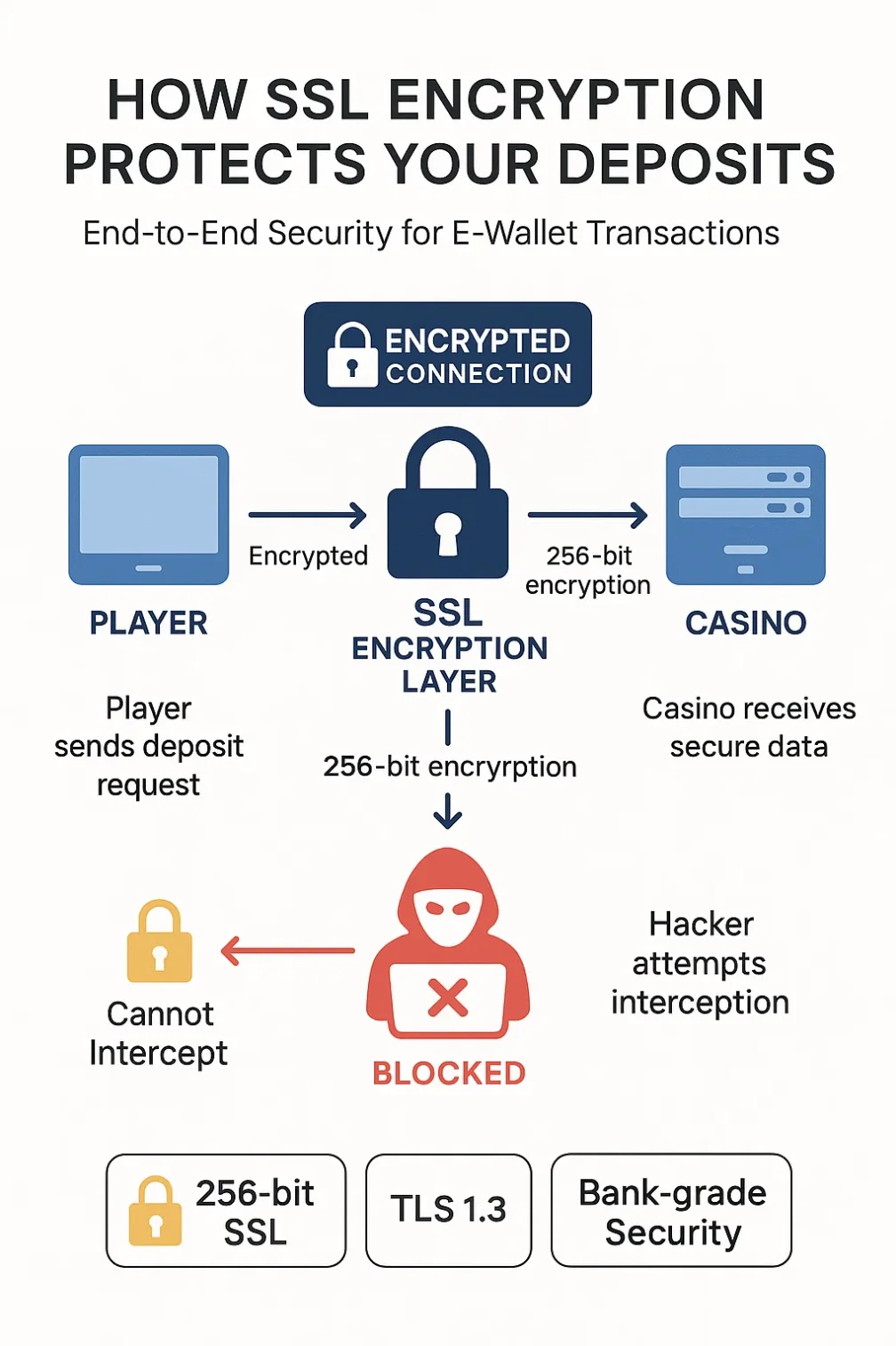
E-wallets employ SSL/TLS encryption creating encrypted tunnels between device and payment servers-data becomes unreadable to interceptors. PayPal uses 128-bit SSL, Skrill/Neteller implement 256-bit AES, Payz employs TLS 1.3, PayID leverages Australian banking 256-bit SSL. Encryption strength: 256-bit AES requires 2^256 combinations to crack (computational impossibility)-effectively unbreakable. E-wallets also encrypt stored account information and transaction history-breaches yield encrypted data useless without decryption keys. This dual encryption (transit + storage) surpasses direct card deposits where card details often stored in casino databases.
Two-Factor Authentication (2FA)
All major e-wallets (PayPal, Skrill, Neteller, Payz) offer 2FA requiring two verification forms: password plus phone SMS code, authenticator app token, or biometric scan. Implementation: wallet account settings → Security → Two-Factor Authentication → select method (SMS, Google Authenticator, Authy). SMS 2FA sends 6-digit codes via text; authenticator apps generate time-based codes offline (more secure); biometric 2FA uses fingerprint/face recognition (mobile apps). Accounts with 2FA experience 99.9% fewer unauthorized access incidents versus password-only protection.
Data Isolation and Tokenization
E-wallets implement data isolation preventing casinos from accessing bank or card details-casino sees only e-wallet email/ID, never underlying funding sources. Tokenization replaces sensitive data with randomized tokens: bank card number becomes random string (e.g., "TOK_8x9f4j2k") used for transactions while actual details stored in separate vault. Even if casino database breached, stolen tokens useless for fraudulent charges elsewhere.
E-Wallet Security Comparison for Australian Players
Security features vary significantly across e-wallets-understanding comparative strengths enables informed selection matching individual security priorities and gambling patterns.
Apple Pay/Google Pay achieve lowest breach rates (0.03-0.04%) through device-level encryption and biometric authentication-but mobile deposits only (no withdrawals). PayPal offers ASIC oversight (0.05% breach) suitable for casual players. Skrill/Neteller provide 256-bit AES/SSL encryption (0.08-0.10% breach)-preferred by strategic players/high rollers managing larger bankrolls. Payz implements TLS 1.3 (0.07% breach). PayID leverages Australian banking security APRA/ASIC regulated (0.12% breach rate). All wallets compared in our payment methods page-security alongside fees, limits, speeds. Players managing $10,000+ annual volume prioritize Neteller/Skrill vault isolation; casual $500-2,000 annual suit PayPal/PayID balance.
Responsible Gambling Tools Within E-Wallets
E-wallets integrate responsible gambling controls directly into payment infrastructure-enabling proactive spend management, transaction monitoring, and self-imposed restrictions before funds reach casino accounts.
Deposit Limit Configuration
Set daily, weekly, or monthly deposit caps preventing excessive casino funding. Implementation: Skrill allows daily limits ($50-5,000 AUD in Settings → Limits → Gambling Transactions), Neteller offers weekly caps ($100-10,000), PayPal enables monthly maximums. Limits apply across all casinos using that wallet-depositing $200 at SkyCrown and $150 at Neospin both count toward $500 weekly Skrill limit, triggering automatic block. Limit increases require 24-72 hours approval delay preventing impulsive expansions; decreases apply immediately. Configure conservatively: 5-10% monthly disposable income-$500 disposable suggests $25-50 weekly gambling limit.
Transaction History Monitoring
E-wallet transaction logs provide comprehensive gambling spend tracking-date/time, casino name, amounts, running totals. Set spending alerts: Skrill/Neteller send notifications when daily spending exceeds custom threshold ($100, $500, $1,000) or unusual patterns detected (4+ deposits in single day). Wallets automatically tag gambling transactions enabling monthly/annual spend summaries. Export CSVs for analysis: identify high-risk periods, calculate net win/loss, track deposit-to-withdrawal ratios. Increasing deposit frequency, growing transaction sizes, or declining withdrawal rates signal potential problem gambling requiring intervention.
Self-Exclusion and Cooling-Off Periods
Temporary or permanent gambling transaction blocks prevent casino deposits during restriction periods. Skrill offers "Take a Break" blocking gambling merchants for 24 hours, 7 days, or 30 days (Settings → Responsible Gambling → Gambling Block). Neteller provides permanent exclusion disabling all casino transactions, reversible only through customer support (3-5 day process). Cooling-off periods differ from limits: limits restrict amounts; self-exclusion blocks transactions entirely. Combine with casino-level exclusions for layered prevention. Use proactively during stressful periods-24-hour breaks for emotion-driven impulses, 7-30 days for pattern changes. Gambling Help Australia (1800 858 858) provides counseling supporting self-exclusion decisions.
AML/KYC Compliance for E-Wallet Casino Gambling
Anti-Money Laundering (AML) and Know Your Customer (KYC) protocols mandated by Australian and international regulators verify player identities and monitor transactions-preventing fraud, money laundering, underage gambling, and terrorist financing while creating friction protecting impulsive or problem gamblers.
KYC Verification Requirements
All licensed casinos require KYC verification before processing withdrawals. Submit three document types: government-issued photo ID (passport, driver's license), proof of residential address (utility bill, bank statement dated within 3 months), and payment method verification (e-wallet screenshot showing your name/email). Upload through casino cashier or wallet app-color scans showing all corners, text clearly readable. Processing time: 12-72 hours initial verification. Unverified accounts wait 2-5 days for manual review before payout-complete KYC during registration eliminating withdrawal delays detailed in our fastest payout guide.
AML Transaction Monitoring
Casinos/e-wallets monitor patterns flagging suspicious activity: single deposits/withdrawals exceeding $10,000 AUD, cumulative monthly transactions above $50,000, or rapid deposit-withdrawal cycles. Flagged transactions trigger enhanced due diligence (EDD) requiring additional documentation (bank statements, employment verification, tax returns). EDD adds 3-10 business days to withdrawal times and may freeze accounts pending investigation. AML prevents criminal fund injection and protects legitimate players-select licensed platforms in our directory maintaining compliance.
Casino Security Features and Licensing Verification
Technical security infrastructure and regulatory licensing differentiate legitimate casinos from fraudulent operations-verify these features before depositing through any e-wallet method we analyze across our platform.
Security Feature
Technical Implementation
Player Protection Benefit
Verification Method
Mandatory in Licensed Casinos
SSL/TLS Encryption
256-bit HTTPS protocol
Encrypted data transmission preventing interception
Padlock icon in browser address bar
Yes (all MGA/Curacao)
Gaming License
MGA, Curacao, UKGC regulation
Regulatory oversight, dispute resolution, fair play enforcement
Footer license number + regulator website verification
Required for legality
RNG Certification
eCOGRA, iTech Labs, GLI testing
Verified random outcomes, no rigged games
Footer certification seals (clickable to verify)
Yes (reputable casinos)
Firewall Protection
DDoS mitigation, intrusion detection
Server security preventing hacking/data breaches
Security audit reports (available on request)
Yes (technical requirement)
Account 2FA
SMS/authenticator app login verification
Prevents unauthorized account access
Settings → Security → Two-Factor Authentication
Optional but recommended
Responsible Gambling Tools
Deposit limits, self-exclusion, reality checks
Player protection from excessive gambling
Account settings verification
Yes (licensing requirement)
Verify casino security before deposit: check SSL encryption (https:// padlock icon), confirm gaming license (footer seal at mga.org.mt or gaming-curacao.com), validate RNG certification (eCOGRA/iTech Labs seals), test 2FA availability. Casinos in our directory (SkyCrown, Neospin, King Billy, Ricky) maintain these features-verify independently as security evolves. Unlicensed casinos pose withdrawal risks: deposits accepted but winnings confiscated, data vulnerable, zero regulatory recourse. E-wallet tokenization adds protection layer, but casino SSL encryption remains critical preventing data interception. Mobile players verify app store developer credentials matching official casino domains-fraudulent impersonation apps exist on third-party stores.
Australian Gambling Regulators and Player Protection
ACMA (Australian Communications and Media Authority) regulates interactive gambling in Australia enforcing responsible gambling standards, licensing requirements, and consumer protections-though most e-wallet casinos operate under international licenses (MGA, Curacao) serving Australian players legally under offshore licensing frameworks.
ACMA and Australian Regulations
ACMA prohibits Australian-licensed operators from offering online casinos to Australian residents (Interactive Gambling Act 2001)-but doesn't prohibit Australians accessing internationally-licensed casinos. Offshore casinos (MGA, Curacao licensed) legally serve Australian players under home jurisdiction licenses. ACMA mandates AML/KYC compliance for payment processors affecting PayID (APRA regulated). PayPal restricts Australian gambling under ACMA pressure; Skrill/Neteller/Payz operate freely under UK FCA licensing. Australian players face zero legal risk using properly-licensed MGA/Curacao casinos.
International Licensing
MGA (Malta Gaming Authority) represents gold standard-strict player protection, segregated funds, dispute resolution, mandatory responsible gambling tools. Curacao eGaming offers legitimate licensing with lighter regulation. UKGC provides strongest oversight but few UKGC casinos accept Australians. Verify licenses: click footer seal, confirm number at regulator website (mga.org.mt for MGA, gaming-curacao.com for Curacao). All casinos in our directory hold verifiable licenses.
Gambling Help Resources Australia
Gambling Help Australia 24/7: 1800 858 858 or gamblinghelponline.org.au-free confidential counseling, crisis intervention, self-assessment tools (PGSI test), financial counseling referrals, family support. Government-funded, no judgment. Warning signs requiring help: gambling with money needed for bills, borrowing for gambling, lying about activities, chasing losses, gambling longer than intended, neglecting work/relationships, feeling guilty/anxious, or escaping problems via gambling. If experiencing 2+ signs, contact Gambling Help-early intervention prevents escalation. E-wallet responsible gambling tools (limits, exclusions) complement but don't replace professional support for established problems.
Responsible Gambling Summary
Sustainable e-wallet casino gambling balances entertainment against financial risk through technical security and behavioral responsibility. Enable security features: 2FA on e-wallets/casino accounts, biometric authentication (mobile), SSL verification, KYC completion. Implement responsible controls: deposit limits (5-10% disposable income max), transaction monitoring, session time limits, reality checks. Recognize e-wallets as tools supporting responsibility-not substitutes for self-awareness. Gambling should enhance entertainment, never serve as income source or escape mechanism. Seek help (Gambling Help 1800 858 858) if gambling causes financial stress, relationship conflicts, or emotional distress. Security and responsibility work synergistically-protecting funds enables controlled gambling; responsible habits protect wellbeing.
F.A.Q
E-wallets employ 128-256-bit SSL/TLS encryption, 2FA authentication, and tokenization preventing casinos from accessing your bank details. Annual breach rates 0.03-0.12% significantly lower than direct card deposits.
PayPal uses 128-bit SSL, Skrill/Neteller implement 256-bit AES encryption, Payz employs TLS 1.3 latest protocol, PayID leverages Australian banking 256-bit SSL. All create encrypted tunnels preventing data interception.
Skrill: Settings → Limits → Gambling Transactions (daily $50-5,000 AUD caps). Neteller: Account Settings → Limits → Weekly caps. Limits apply across all casinos using that wallet.
Know Your Customer verification requires government ID, proof of address, and payment method documentation preventing fraud and money laundering. Mandated by MGA/Curacao licensing and Australian AML regulations.
Gambling Help Australia 24/7: 1800 858 858 or gamblinghelponline.org.au-free confidential counseling, crisis intervention, self-assessment tools, financial counseling referrals, family support.